Sunday, 1 July 2012

Ontario - Part 2: Being Canadian

Having no ticket between Toronto and Ottawa, I was planning to hitchhike all the way, but having no idea where to start hitching, I went by bus as far as Kingston.


For a while, Kingston was the capital of Canada, until Queen Victoria decreed that it was too close to the US border and thus too vulnerable to attack. Wandering around the centre of Kingston, one really feels that one could be in a small town in England or Wales.


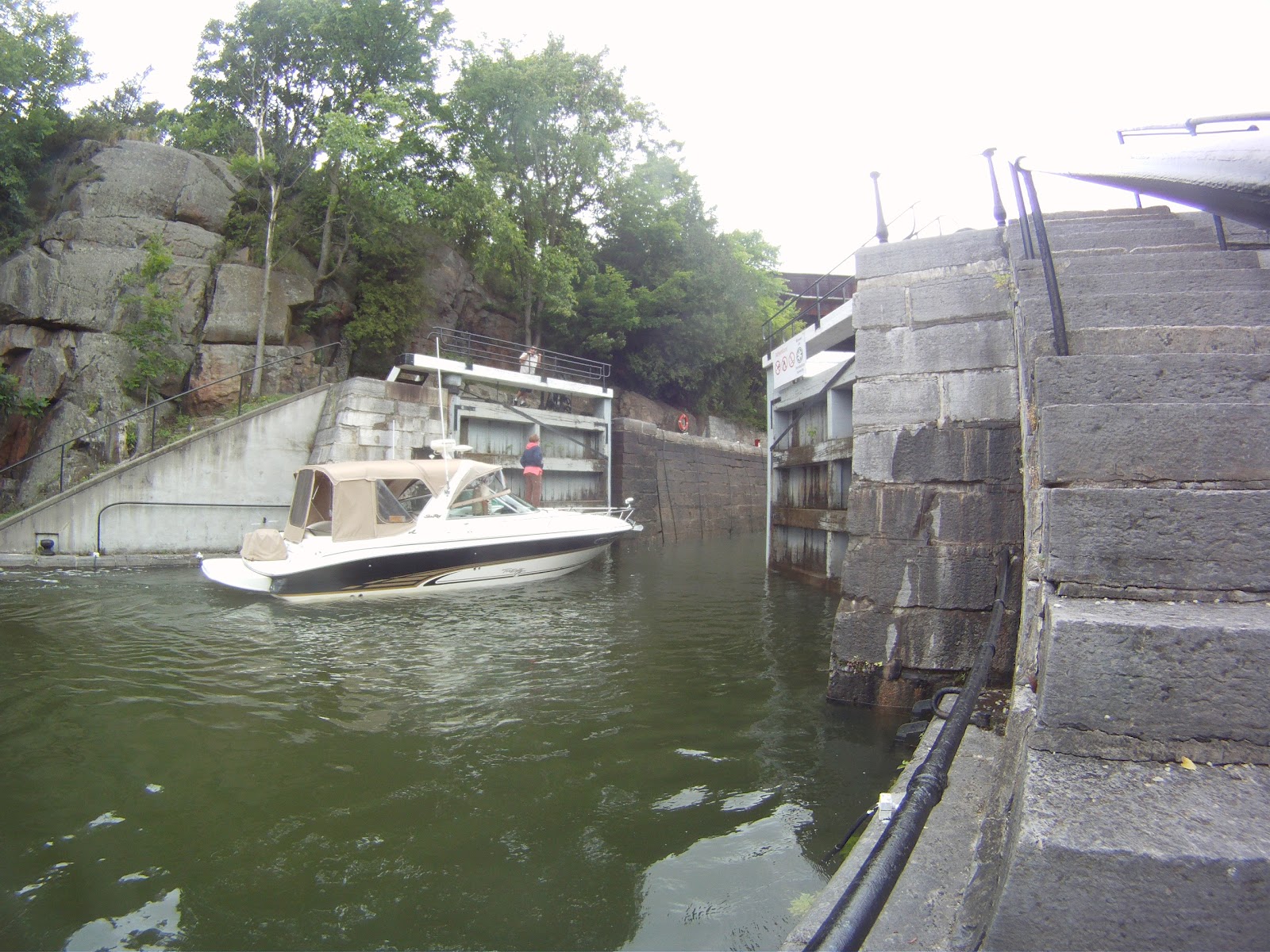
My accommodation in Kingston was a camper van. The owner of the van was Andrew, and his parents kindly showed me all around the town, and around the river basin. From here, the first flight of locks starts the Rideau canal that joins Kingston and Ottawa over the hills and through a series of lakes.


 Andrew's parents also have a cottage near a Provincial Park north of the city, and were kind enough to take me there for a day, to experience what being Canadian in the summertime is really all about. 

 
Being on an island in a lake, their cottage is only accessible by canoe, and we spent a beautiful day there canoeing around, repairing the outhouse which had got hit by a falling tree, and swimming amongst sunfish and watersnakes in the balmy waters of the lake, in between sessions sitting cooking in the home-built wood-fired sauna.

Canoeing across Otter Lake


The following day, I had arranged to go and visit Bruce, a friend of my mum's, who lives in the Lanark area of Rural Ontario. Bruce had agreed to come and pick me up in Kingston. I knew which shop we had arranged to meet outside, so waited there at the pre-arranged time. It was only after 45 minutes wait that I realized I was waiting at the wrong branch of the right shop, on the right street, but at the wrong intersection. By the time I got to the right place, Bruce had already given up on me. So it came to pass that I reverted to Plan A and hitchhiked out of Kingston. Three rides in as many hours got me as far as the home of my third lift-giver, which was a luxurious trailer in a park on the side of a long and beautiful lake.


The trailer park is apparently rather looked down upon in Canadian and American culture as not such an ideal living situation. But this place was idyllic!


 Trees, water, beautiful sunshine... what more could one possibly want‽


After a swim in the lake, I contacted Bruce and found that I was not too far from his home, so we arranged that he would pick me up nearby. 

I stayed with Bruce for 3 days, exploring the surrounding countryside by various means of transport. The area was originally settled by Scots, as is reflected in the local names of places and rivers. Many of the local inhabitants are descendants of the original settlers. The land is farmland but being very stony, is apparently very difficult to farm.It makes for good cycling country, though.


Note the well-built wooden fence, of which there are many in the area.

Perth

We also enjoyed fresh vegetables from Bruce's highly productive garden that needed a lot of watering given the lack of rainfall.


On my last full day with Bruce, we went with a friend of his for a kayaking expedition along the Mississippi river (this is not the American Mississippi, but a much smaller local river).


We went up along the Clyde river, a tributary of the Mississippi and found the way blocked by a beaver dam. Never mind, though - we continued in the Canadian way by ramming the dam and heaving ourselves and our kayaks over it into the upper stretch of water, and did the same going back downstream:


Having experienced kayaking over a beaver dam, I began to feel like a Real Canadian! 

The final stage of my Canadianization was Canada Day, for which I chose to be in Ottawa, the capital city. 


I set out in the morning, adorned myself with Canadian Flags, and walked into the city along the northern end of the Rideau Canal.


  I started to pass more and more people dressed in red and white, and was glad I had dressed for the occasion.


Thursday, 21 June 2012

Ontario - Part 1: Being International


Ontario is a Huge province, even by Canadian standards. I planned to attempt to fit the entire province into a single 'blog entry, but this was futile. Two 'blog entries is still not quite enough, but that is what I must do...

The penultimate day-and-a-half aboard the train was spent entirely within Ontario, travelling through forest which was interspersed by a great many lakes. I have no idea how the designers of this railway could ever have even started to survey for planning to build this railway. It seems to pass through otherwise completely impenetrable forest for thousands of kilometres. It must have been like digging a tunnel through the forest.


The section of Ontario just north of Toronto is known as "cottage country" as it is where a great many inhabitants of the Greater Toronto Area have "cottages". These are not cottages as we know them in England, however, but holiday homes and weekend getaways that range from mere shacks in the woods, to castles on lakeshores.


As we got closer to Toronto, the landscape became more and more developed and the cottages became grander and more castle-like, and very soon we were passing through suburbia. I stepped down from the pampered life aboard the train, into Canada's larget metropolis.

It was immediately clear, wandering the streets of Toronto that there were a multitude of national groups living there. The fact that the European Football championships were on at the time I was there made this even clearer: cars passing by were often bearing the flags of Portugal, Greece, Italy and such like. Perhaps this happens even when football (or soccer, as it must be called over here) is not an immediate concern.
I spent a few days in the city wandering around, sampling some of the varieties of cuisine and enjoying the contrasting architectural forms.


The latter range from a university campus very reminiscent of parts of Oxford and Cambridge, to a great crystalline window crashing through the carcass of a grand 1920s building. And towering over all are the downtown skyscrapers, themselves dwarfed by the CN tower, ever present on the horizon.


I spent a day away from the city on the typical tourist's pilgrimage to the Niagara Falls. As these falls are mythologized beyond realism, I was not expecting to be impressed, but surprised myself. I fortunately made the decision to walk to the falls along the river from the bus station, rather than taking a city bus or walking through the town. This gave me a view of the deepening canyon, and a more naturalistic approach to the falls. The American falls, which were the first that I saw were incredible enough, but the horseshoe falls on the Canadian side of the river are as phenomenal as their reputation would have one believe. It was a sunny day, which gave rise to an aspect of the place I had never cnsidered: there is a permanent rainbow in the vicinity of the falls! I was surprised how close it is possible to get to the top of the falls, and felt no need to engage in the tourist activities such as a walk down into the tunnels behind the falls, or a boat trip on the river below. Instead was content to sit under a tree near the falls and read. In staying still for a long time, I became aware of the most amazing phenomenon: as the sun sank towards the horizon, the rainbow bubbled its way out of the gorge.


I then wandered into the built-up area adjacent to the falls, and experienced the most dire of geographical culture shocks. I fancied I was suddenly in Las Vegas or Blackpool or some such monetary quagmire. Everywhere there were towering blocks of casino hotel and billboards encouraging me to part with my money in various ways, by spending an evening with this or that minor celebrity or attending the tackiest seeming side attractions. Someone had mentioned to me that one thing worth visiting was the nightly light show at the falls, but after the rainbow's most exquisite natural light show, I felt no need to wait around for the man-made projections on the falls in the evening, and got the early evening bus back to Toronto.

Friday, 15 June 2012

"The Canadian" - Part 2: Jasper to Toronto

Leaving Jasper by train was magnificent. Although we passed through increasing rain showers, the clouds were somewhat broken, so the majority of the mountains were visible, and  unbelievably dramatic.


This majestic scenery was over all too soon as we wound down through forest, out of the rain and the Rockies into Alberta's farmland. As the train pulled into the industrial outskirts of Hinton, I overheard one of the other passengers say, "Man doesn't make it very attractive, does he?" I found myself wondering whether Woman would make it any more attractive...

Travelling in the sleeper class was a whole lot different from the economy class I had experienced on the way from Vancouver to Jasper. I knew that the ticket included all meals, but was not quite expecting the quality that entailed: 3-course meals three times a day, with six pieces of cutlery for each; extra muffins and patisserie for anyone who had to wait for breakfast, and bowls of fruit scattered throughout the carriages.

The Dining Car laid out ready for a meal


After the first evening meal, I wandered along to the rear of the train, which is a carriage with windows all around the back. Here there were many bowls of fruit, hot drinks on tap, and a gaggle of retired Texan ladies fawning over pictures of the Queen's Jubilee celebrations. Arriving there just at the same time as me was a singer-songwriter guitarist. As she was tuning up, I imagined myself to have wandered into a private part of the train, but then realized that this was all included!


As I had found in Jasper and in Whistler, travelling with an accordion really opens doors. Karen the guitarist said I should go and fetch my accordion, and so I did. Although we didn't jam as such, I did play a few tunes for the gathered audience, many of whom thought I was also a hired musician on the train. The following afternoon, during my wanderings along the various sections of the train, I heard an chirpily enthusiastic English accent say, "Are you going to play for us?" so play I did, and I stayed at that end of the train until my call for supper.


I visited the economy end of the train a number of times over the next few days, and I began to feel almost like a kind of aid worker taking music to the starving refugees of some place from which culture had been banished.


Every now and then along the route, our train had to stop to allow freight trains heading the other direction to pass us. It seems that most of the railway across Canada is single-track, and freight transport, being the main income of the railway, has precedence over mere passenger trains. Being in no particular rush, I was quite happy for the train to go a little slower. I was very content to be on the train for a good long while, feeling that even three days was far too short a time.


The sleeping accommodation on this train was different to any other that I have experienced. It was probably most similar to the Russian train in which I crossed Europe in May 2010. In the daytime, the bunk was folded up into an impossibly small space, above forward and backward facing seats.


During the evening meal, the carriage attendant would come and fold out the beds in some impossibly complex series of key-turns and lever-pulls. The first time I returned to my berth to sleep, I walked straight past it as it was so completely different a space than the daytime configuration.


I realized soon after inhabiting my upper bunk why it was cheaper for this than the lower bunk: the lack of windows meant that there was no way to experience from one's bed that wonderful pleasure of overnight train travel: waking up in the early morning light to experience a strange landscape, different to that which has been left the previous evening. I was able to experience this joy by getting out of bed, however, as the bunks opposite, not being inhabited between Edmonton and Saskatchewan, were still in the daytime configuration.


After sitting for a while and looking out at the early morning strangeness from the other side of the carriage I went back to bed,as it was still a while before breakfast time. The second time I awoke on that first morning, we were already in the prairies. I had somehow been led to believe that these lands would be far flatter than they actually were. Only briefly did we ever pass through anything nearly as flat as the Fen country in the East of England. Also, I somehow had an image of the prairies being wild grasslands, so was a little disappointed to find that all the land that we could see from the train was cultivated for agriculture, or quarried for Potash.

Some time between breakfast and lunch, I realized that this train had showers on board, and decided to sample the delights. The shower room was surprisingly spacious, and the flow of water was properly strong. It was a pleasure to be warm and wet and to watch the water trickling down through a small hole onto the tracks below.

Life on a long train journey is really rather leisurely, and it is easy to lose track of time. If it were not for the regularly announced mealtimes, and the darkness of night-time, the time of day would cease to exist at all.


The train in Hornepayne, wildest Ontario
Waiting in Hornepayne to get back on the train

Tuesday, 12 June 2012

Jasper - Part 3: Tourism


I had been considering trying to get to Miette Hotsprings, but when I telephoned them in the morning of the following day, all I got was a recorded message saying that due to excessive rainfall, the temperature of the pools was no longer hot enough, so they would be closed until further notice. My plan B was to go and see the lakes of Maligne River: Medicine Lake and Maligne Lake. Since the distances involved in my goals were not walkable, I decided to try my hand at hitchhiking, and around 11am went to stand on the road outside the Maligne Hostel, playing my accordion as I waited. 


I was picked up after a very short time by a couple of Belgian ladies who asked if I didn't mind that they would be driving very slowly in the hope of seeing wildlife alongside the road. I didn't mind at all. So we joined the tourist train of cars driving along the road and helped contribute to the traffic jams that occur whenever a bear, deer or mouflon (bighorn sheep) is spotted alongside the road. Such wildlife-spotting traffic jams occur regularly in places like Whistler and Jasper, and probably everywhere that tourists and wildlife share space. A side-attraction is seeing the various risks taken by those tourists who seem to be oblivious to the fact that even one of the smaller black bears could render them lifeless - or at least do some serious damage - with a swipe of the paw. It is amazing how much psychological protection is afforded by the roadside crash barrier. For the most part, black bears will continue grazing and ignore the tourists and their cameras, but you can never know how close is too close until it is too late. And what constitutes "too close" is always dictated by the bear.
"Black" Bear shining brown in the sunshine grazes oblivious to tourists
 We drove on up the road, losing the river somewhere in the forest, and after a while, we came to the first lake.


Medicine Lake has a very curious property: the water level changes considerably based on the outflow through the various tunnels of the canyon. In fact, there is no visible river flowing out of this lake, as all parts of the river go underground  here before emerging at different points in the canyon. For me, the most wonderful aspect of this lake was the profusion of dandelions that abounded along the shore. 


Not quite sure why, but i just love these flowers! Apparently black bears also love dandelions, so it was no surprise that there was a mother and two cubs grazing around the lake. There was the usual crowd of tourists with cameras keeping a sensible distance away.


We continued up the road which wound round the lake then passed between snowy peaks then over a slight rise and down to Maligne Lake.


Maligne lake is the largest natural lake in the Canadian Rockies, and contains Spirit Island, one of the most photographed islands in the world. It is very popular for canoeing and also has a large number of sightseeing pleasure boats on it. This end of the lake seemed very touristy, although peering into the distance, I could just see the majestic mountains at the other end of the lake which are, no doubt, along with Spirit Island, the reasons for the tourism. Although tempted, I did not fork out the money for a boat trip or a canoe rental, but explored the woods along the lake shore on foot, and found a trail through the woods to a smaller quieter lake beside which I sat and played my accordion.


Hitchhiking away from Maligne Lake proved impossible using the traditional method. Despite there being only one road, the only cars who even acknowledged me were those that already seemed to contain more people than seats.


So I resorted to hitching by tongue instead of thumb: waited in the car park, I asked anyone who approached if they happened to be heading down towards Jasper. Although the first few peple I asked had full vehicles, this strategy of vocal connection seemed to humanize me in the eyes of those who may not have picked up a traditionally posted hitchhiker. Then I met an Austrian-Canadian named Steve. At first he was wary, but after finding out that I was British, his trust level increased, and he agreed to take me part way to Jasper - although he was headed East so could not take me into town. Amongst telling me about his life as a furniture maker and cattle farmer on his farm in Alberta, Steve gave a possible explanation of why people in these parts are loathe to pick up hitchhikers: some years ago, a couple were murdered by someone who had hid in the back of their camper van while they were filling up on fuel. This story has nothing whatsoever to do with hitchhiking, except to reinforce the concept of the vehicle as one's personal space into which one should not let anyone who one doesn't trust. It is devastating, then, that stories such as this then somehow lead, by extension, to a general mistrust of hitch-hikers.

Steve told me he was heading to Miette hotsprings on his way home. He said the springs might have warmed up by the time we got there, as it was already late afternoon. It was tempting to accept his offer of a lift up there, but I knew that it was an hour's drive to Miette. Not knowing how I would get back to Jasper and not wanting to hitchhike in the dark or risk missing my train the next day, I decided to forego the offer. I was also anticipating that there might be a chance for a reunion of Sparky and the Troubadours with Leif and Liz at the hostel.

Steve dropped me on the highway just by the entrance to a path known as Bighorn Alley that led back to Jasper. I initially thought it was so-called as the path went alongside the railway and was therefore frequently subjected to the sound of the horns of passing trains. But seeing the sign at the entrance to the trail, I realized that the name refers to the animals.


I walked back into town and didn't see any longhorn, but did see large numbers of what appeared to be logs sticking out of the grass. As I looked around, however, and the logs started to disappear and reappear at random intervals, I realized that these were not logs but ground squirrels, and moreover, I was completely surrounded by hundreds of these creatures!

Ground Squirrels - invisible to the camera in their natural habitat
From Jasper, I was frustrated by not being picked up hitchhiking, but walking all the way back allowed me to see a family of elk crossing the road near the hostel. 


Back at the hostel, there was no sign of the Troubadours, so I busied myself preparing my baggage for the train journey the next day.

Contributors