Monday, 11 June 2012

Jasper - Part 2: Wilderness


There are many hostels in the Jasper area, and most are "wilderness hostels" - huts in the woods with only basic ameneties. I decided to spend a day walking to the Maligne Canyon hostel and stay for the night before returning to the main Jasper hostel the following day.


Some time before noon, I set out and walked through the sunshine down the road to the highway. Despite enthusiastic thumbing, none of the passing cars or mobile homes picked me up, so it started and remained a walking day.

I first returned to the place where the rivers meet, to see the confluence in the sunshine.


From there, I wandered through the woods to the nearest bridge and crossed over the Athabasca river to a vast rock known as Old Fort Point. Here, I was surprised to learn that the Athabasca river flows all the way to the Arctic!


Continuing through the woods (along local footpath 7b) I met a park ranger who recognized me from the night before. He advised me that since it was already 2pm, I should probably take the more direct route to the hostel, as there were still another few hours to go. However, I felt I should follow the advice of a fellow Englishman I had met in the hostel, who had told me that the bottom of Maligne canyon was just as worth going to see as the top.


 I decided to take the longer route which cut across through the forest to the Athabasca river and then up the Maligne river. 


Walking up along the Maligne river, it seemed first to be a relatively normal, though picturesque, river rushing through the woods. As I continued, the path wound along at the bottom of the wooded slope at the river's edge, and crossed a number of small streams. Most of the streams, although rushing, seemed to come from nowhere.


These were the springs from which the underground parts of the Maligne river sprung back to the surface. Further up, the river valley narrowed into a rocky canyon that got higher and steeper as I went further up.


As I gradually got further and further up the canyon, more underground streams appeared at the sides, and the amount of water in the visible river got less and less. The canyon got more and more spectacular as I continued upstream.


The canyon also got narrower, and the path crossed it by a series of footbridges. I remembered that I had in my backpack a length of nylon string. Deciding that this was too good an opportunity to miss, I spent some time attaching my camera to the string and lowering it down into the canyon to obtain some rarely seen views of the canyon.


I arrived in the evening at the top of the canyon, where there was no sign of what strange and marvellous formations are so near by. After exploring the area, I eventually found the hostel, which consisted of a small group of cabins in the woods by the river.


The water supply came from a big tank in a shed, and the toilets were outhouses. There were also strict rules about keeping food only in the kitchen cabin, as the area is often home to several bears. According to the warden at the hostel, there were presently six grizzly bears between this hostel and Jasper town. Since wildlife observation forms part of his duties for the National park, he knows every bear and pack of wolves that is in his territory.
Originally from Austria, the warden settled in Jasper in the mid-1980s, after travelling the world. I had to agree with him that Jasper is surely one of the top places to be.

Sunday, 10 June 2012

Jasper - Part 1: Civilization

Arriving in Jasper reminded me - for no apparent reason - of arriving in Ulan Bator. Perhaps the shape of the station was similar, or perhaps I subconsciously pre-empted the similarity of the structure of my stay there - a couple of days in a hostel, a couple of days adventuring through the "wild" and another stay in the hostel, before departing. It was raining slightly when I arrived, and I learned that there had been a greater-than-usual amount of rain this year. I caught a shuttle bus to the hostel, where I experienced culture shock due to an atmosphere totally different to that on the train. Rather like the hostel I stayed at in U-B, the HI-Jasper was crowded with people who were engaged in various exciting-sounding activities in the area. Feeling a little lost in the crowd, I relaxed and wrote my diary, and chatted with one or two people. I had just decided to go to bed, when someone asked me if that was an accordion I had over my shoulder, and if I would demonstrate how it worked. I played a few notes, and very quickly a small crowd gathered, consisting largely of those I had been talking to. I continued playing, and Emily, the girl from the front desk approached, and asked if I would keep my playing short, since it was nearly time for the quietness curfew. She added that if I wanted to do a show the following evening, I could have a free night's stay in return. Which sounded like rather a good idea to me.


I finished playing, and wandered through the kitchen on my way to bed. In the kitchen were another couple of people who were interested in my accordion. Liz and her son Leif were on a road trip from their home in Juneau, Alaska to California. They told me they were fiddlers, and we should get together for a jam the following night. Passing by the front desk, I told Emily that there would now be 3 for the next night's gig, and she said she would arrange everything and went to talk with Leif and Liz. I helped her write a sign, and somehow, between the four of us, we came up with the band's name. Despite the fact that Liz and Leif had once been in a band called Taco, and I played with the Takoband in Japan in 2004-6, somehow it did not seem appropriate to regurgitate this name based solely on serendipity, so we became Sparky and the Troubadours.


Hey! I don't remember any free popcorn!

The following day, someone mentioned to me that there was an open mic / jam session at a bar called the WhistleStop in town. So I decided to go and investigate. I hitched a ride into town with some of the hostel staff, who were appreciative of my soundtrack to their driving. Turning up at the WhistleStop, however, my whistle was indeed stopped: the jam session had been the previous evening. Instead, I found a shelter from the rain in the form of a four-sided information board, under which I stood and played to the four walls, myself, and some presumably rather confused passers-by who could only see my lower legs and feet.

I walked back to the hostel, and on my way, I passed by the place where the rivers meet. This is the main thing I remembered from visiting Jasper 20 years ago. One of the most stunning and interesting aspects of Jasper, the confluence does not seem to appear in guide books or tourist literature. The Miette river is a brown colour and flows down from wooded mountains to meet the glacially-fed Athabasca river, which is a blueish-grey colour. The confluence of colours creates patterns and swirls that continue for many hundreds of metres along the Athabasca river - it is possible to see exactly which water came from which river, and the interference patterns that result are hypnotizing.


The "concert" in the evening was an informal affair. We took up our places on one of the tables in the common area, and were announced to those gathered in the room. Sparky and the Troubadours proceeded to play together for the first time, exploring the synergy between their Irish-based folkiness and my free-form meanderings and sporadic chord changes.


Saturday, 9 June 2012

"The Canadian" - Part 1: Vancouver to Jasper


At the Pacific Central Railway station in Vancouver, I was surrounded by musicians. They were involved in some sort of promotional on-board music programme called Tracks on Tracks, the majority of which I would miss out on, partly due to being in Economy class, and partly due to leaving this train in Jasper.
The musicians were all accommodated in the Sleeper class section of the train, and the only two I met were taggers-on who had got involved by dint of being friends of the organizers.


Soon after 8pm, I was ushered into the economy carriage, where I carefully chose a seat with no seat behind it so that reclining could be performed without the need to disturb other passengers. I need not have worried about this, as there were very few people in the carriage: indeed, there were few enough that I felt comfortable squeezing a few chords out of my accordion. Along with the bright sunshine streaming through the window, it was a good start to the journey. It felt good to be getting on a train again. Trains have a greater feeling of potential than buses. The wheels connect to the rails, and the rails run to the destination - the traveller therefore feels connected to the destination in a direct way. My first destination was Jasper in the Albertan side of the Canadian Rockies.


Soon after I put down my accordion, a man came along the carriage, and, telling me what a good choice of seat I had made, settled in to the equivalent seat opposite. Although he was carrying a guitar case, he was not involved in the "official" music scene aboard the train, and I noticed that he was wearing a Victoria busking license. I had done some busking last summer in Victoria, so we talked for a bit about busking and music. Or to be more accurate, he talked, and I listened. His name was John, and by dint of being an ex-railway freight yard worker, he has a free pass for unlimited travel on the railway. He seemed largely obsessed with food, but also covered a wide variety of other topics, all of which flowed together in one long stream-of-consciousness, based partly on the miscellany of  snacks, vegetables and tins of tuna he produced from his bag, partly on what was passing by the windows, and only occasionally based on what he had been talking about in the previous sentence.

It takes effort to listen actively, and my activity on this train journey consisted largely of nodding, chuckling politely, and looking out for gaps in the dialogue that were long enough to allow me time to turn around and look out of the window at the spectacular scenery.

One of the joys of overnight rail travel is waking up early in the morning to find oneself passing through unfamiliar landscapes. On the morning of this journey, I woke up twice in two different and disparate places: first was a greyish desert land through which we passed along one side of a big winding river valley, as freight trains passed along another railway on the other side of the valley.


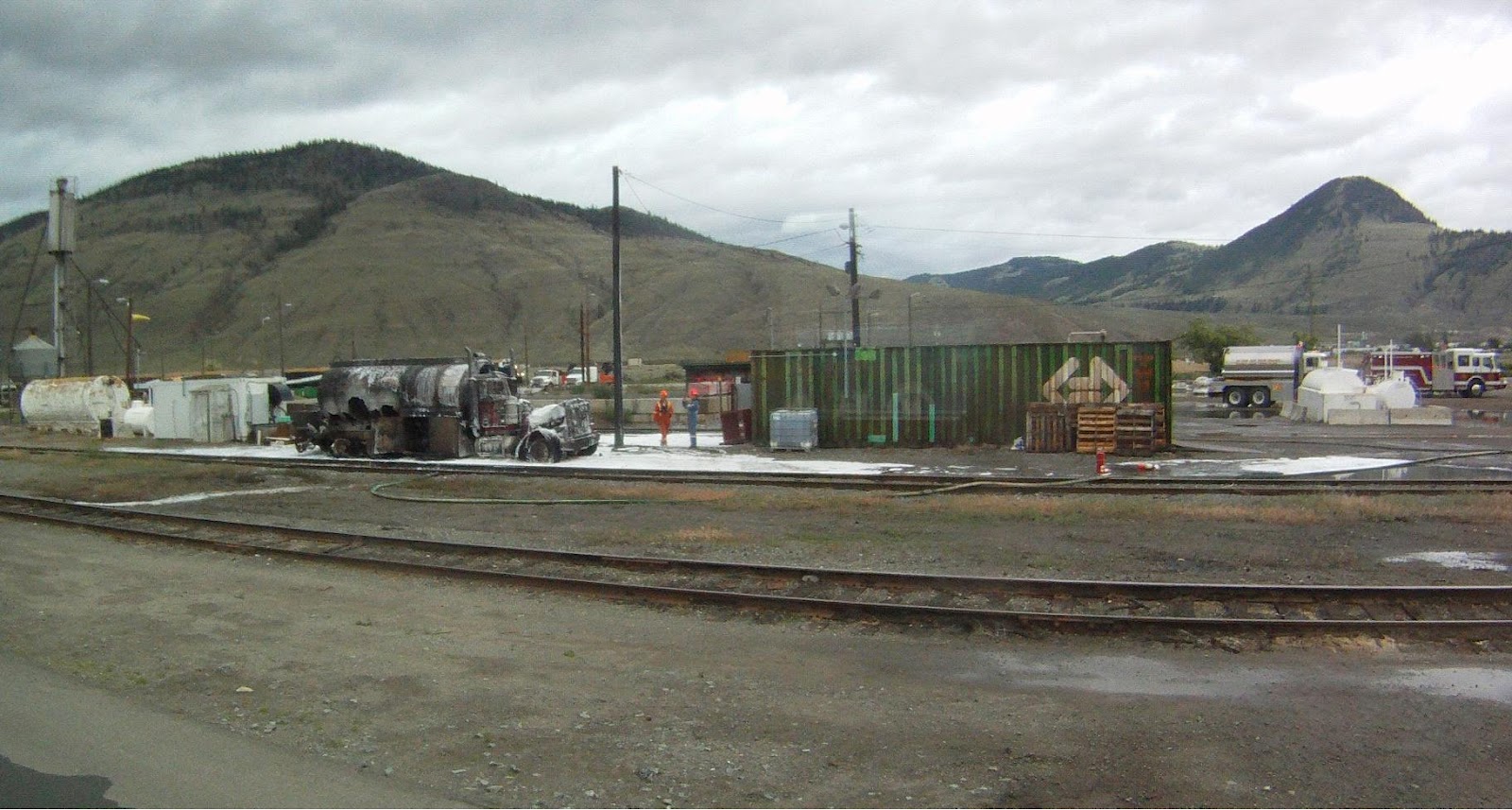
Early morning Kamloops desert

Having dozed off, I awoke for a second time, to the sound of people wondering how long ago "it" happened. In my somnolent state, I wondered if the end of the world was with us 6 months early, but looking up, I realized the nature of "it": Near the station was the burned-out shell of a petrol tanker, dripping with foam, with a group of firemen standing around and starting to gather up their hoses. We later learned that the tanker had stood there for 3 days unmanned, and the fire had started apparently spontaneously.


This was Kamloops, which seemed to be surrounded by fewer trees than I remember from when I passed through 20 years ago; perhaps this was an optical illusion stemming from too long spent in Whistler's coastal rainforest, or perhaps many trees have been logged and not replenished.


 The journey to Jasper took around 20 hours from Vancouver, and apart from the times he was asleep or wandering the length of the train, John gave me a running commentary all the way. He told me about all sorts of things (I wish I'd had a tape recorder - a whole book could be written of what he told me) including the way the trees have changed - the pine beetle has devastated much of the forest, as can be seen by the patches of reddish-brown colour in the mountains in between Kamloops and the Rockies.


The Great Canadian Wilderness

The elusive Mt. Robson
Entering the Rockies, we passed by the elusive Mt. Robson - "only 100% visible on 14 days per year," according to the train announcer, and clearly less than 50% visible on this particular day - then Moose Lake, one of the largest lakes in the Rockies.

Moose Lake

 On the final approach into Jasper, numerous black bears were seen running into the woods from the grassy sides of the railway line. This prompted announcements over the train's PA system of "Bear on the left! Ours à la gauche!"

Spot the bear, anyone?
 John told me he's seen so many bears in his life that it is no longer a big deal to see them from the train. I must say that after living in Whistler for an autumn and a spring, I feel pretty much the same way.

We were now in the Rockies, and the railway town of Jasper was just around the corner.

Thursday, 31 May 2012

Whistler

Sproatt Mountain and Alta Lake


The time has come when I must move on from Whistler.


Whistler is a strange town - it is a wonderful place with amazing mountains and - the primary draw for most of its visitors - fantastic skiing and snowboarding. The town is very much a resort: the original reason for its development was to host the Olympic games. Now that that has happened and the Olympics are over, the town seems to have something of an identity crisis. There is a subtle undercurrent of paranoia that Whistler will lose the interest generated by this event, which leads to the feeling that it needs to continue providing exciting events to ensure that people keep coming. Since people will surely keep coming for the mountains anyway, I don't think Whistler needs to worry so much (is it actually possible for a town to worry?)


Whistler is home to a large variety of people from all over the world: dominated by Aussies, but also including (in no particular order) large contingents of Québecois, Brits, Japanese, Swedes, other Europeans, Kiwis, Mexicans, South Americans, Filipinos, Koreans... The majority are either passing through or came here from elsewhere and stayed. There are, however, two groups of people whose roots here go back further than even the deepest-rooted Canadians: Whistler is situated at the meeting point between the nations of Squamish and Lil'wat. Fortunately, there is a wonderful cultural centre (Olympic-funded) that assists with an understanding of the traditional cultures of these two groups of people.

Stability in my life seems to lead to an absence of diary writing and blogging, but by no means an absence of activity. While a lot of the time, I joined my brother in the "ski/snowboard, eat, work, sleep, snowboard/ski" life-cycle of the ski-bum, the following links document some of the other activities I engaged in during the time I was living there.


Performance Architecture
Accordion Snowboarding
Whistler Bottles

I have been living with my brother in this international ski resort town for the last 8 months. He has gone back to Europe and his beloved Chamonix. 


I now resume my journey's eastward momentum.

Thursday, 22 September 2011

Cortes Island


Many of the islands in between Vancouver Island and the mainland were discovered by Spanish explorers, so have names like Quadra, Sonora and Cortes. After spending most of August in Victoria, I went with my brother Steve up to Cortes Island where he has his boat moored in Gorge Harbour. 


Cortes is reached by two ferries: the first takes 10 minutes to cross from Campbell River on Vancouver island to Quadra island, and the second takes a bit longer to cross from Quadra to Cortes Island.


The Ferry port on the far side of Quadra Island, looking towards Cortes Island
On a ferry, hitch-hiking is best done with the voice rather than the thumb. Talking to people on the first ferry enabled us to cadge a lift across Quadra Island to catch the next ferry as well as a lift on Cortes island from the ferry terminal near Whaletown to Gorge Harbour.

The pond at the Gorge Harbour campsite
 The settlement of Gorge Harbour has the feel of a campsite in the woods - in fact, that's exactly what it is. There is a little shop, a building containing toilets, showers and laundry facilities, a restaurant and a small open-air swimming pool and a rain shelter (very necessary given the climate); all of this is centred around a set of floating pontoons so small it could hardly be called a marina. Out in the bay there are various mooring buoys with boats tied to them, and it was one of these that Steve's boat, Jabula was tied to.


Our first mission was to find Steve's canoe, which he had hidden in the woods. This enabled us to paddle out to his boat, which served as a good home for us for the next two weeks, treating Jabula very much as one might treat a cottage in the Welsh Mountains. As it happened, the weather was often rather similar to Welsh Mountain weather - although slightly warmer.

Arriving at the boat
Jabula from below


there's a rudder in there somewhere


The harbour takes its name from the narrow rocky channel, that links it to - and separates it from - the Strait of Georgia. We took a couple of forays out from the harbour out into the Strait, but didn't get much further due to winds that were too light or in the wrong direction, a fair amount of growth on Jabula's hull and rudder, and our general unwillingness to spend money on fuel given that this was a sailing boat. But we didn't need to go far to enjoy it:


Captain Steve


 We experienced a beautiful simultaneous sunset and moonrise, with sky gradients in the style of the latter work of Roy Henry Vickers.


Realizing that our navigation lights were not working, we found an overnight anchorage off another part of Cortes Island.

Landfall in the Smelt Bay Provincial Park
In the morning went ashore to explore a small provincial park, before returning to the boat and sailing (yes, we did do some sailing!) back to Gorge Harbour. 


We did some exploring around various parts of Cortes island, tramping along gravel roads and trails that wound through the temperate rainforest and emerge at various desolate fjords and inlets.


After one damp day of hiking, we braved it through the close-treed wetness of the rainforest to a final awesome cove with a dead fridge, an old saucepan, some beautiful rocks, no orcas and a rainbow.


Steve and moonrise

 There are wolves on the island, and one night we were sure we heard them as we wandered through the dark.
Sunrise


Steve on his way to go and wash the dishes

Diary excerpt, Sep.19th 2011:

Today has been an awesome day! We have accomplished a mission that had been on the cards for some time: canoeing around Gorge Harbour. We made a figure-of-eight loop around the harbour's two small islands, making a ring around Ring island, and getting a tan going around Tan island.The beautifully clear waters were teeming with life: thousands of purple starfish, many jellyfish, and many seals which popped their heads up from time to time.
Log dump and old cargo barge.
We had lunch sitting on the rocks on the far side of Ring island, and later swam off some rocks further round.  

Steve canoeing around the harbour

After two weeks spent in this way, we started to follow leads for jobs at ski resorts on the mainland, and very quickly, we found that we were being offered interviews  in Whistler, which quickly necessitated our departure from Cortes.


Contributors